



Beyond Infrastructure: Why the WASH Sector Needs Local Private Providers to Reach the Underserved
Our experience shows that formal partnerships with local WASH providers can serve three to four times more people per…


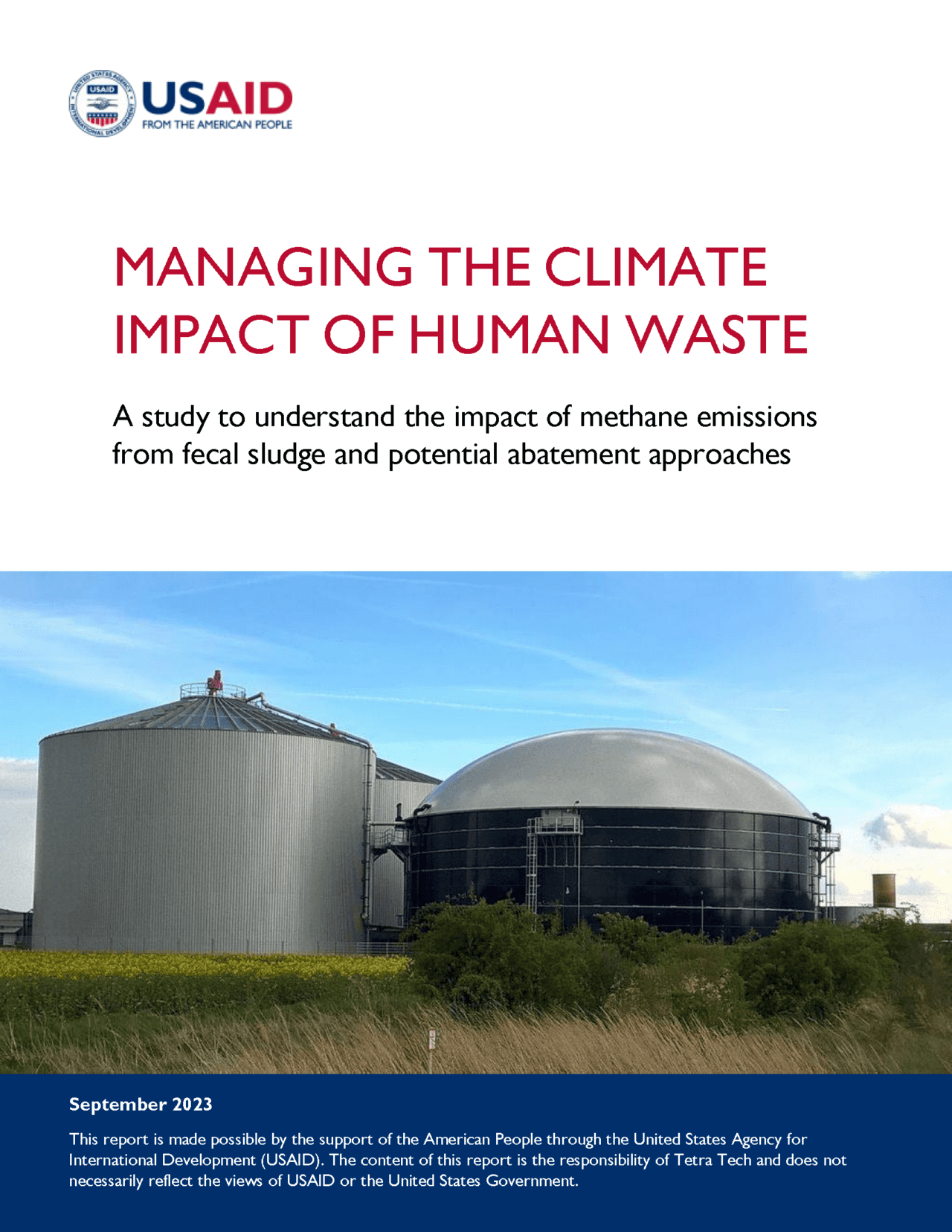
Today, methane emissions are the second largest driver of global warming, accounting for roughly 20 percent of global anthropogenic greenhouse gas emissions (United States Environmental Protection Agency 2022). Methane emissions from the sanitation sector have been estimated to contribute between 7 percent and 10 percent to global anthropogenic methane emissions (McKinsey and Company 2021). However, these estimates focus on wastewater from sewered sanitation systems and do not account for the emissions from non-sewered sanitation systems, typical in many low- and middle-income country (LMIC) contexts. Abatement of emissions from such sanitation systems can play a part in the climate action plan to curb methane emissions.
The study is based on emissions modeling and literature review to identify approaches that can abate methane emissions from sanitation in urban LMIC contexts. This product was developed by USAID’s Urban Resilience by Building Partnerships Global and Applying New Evidence in WASH (URBAN WASH) Activity.
Top Takeaways
Methane emissions from sanitation in LMICs are significant: Sanitation systems in urban sub-Saharan Africa contributed 3-5% to total anthropogenic methane emissions in 2020. This can grow to 8% in 2030, driven by the use of anaerobic containment and treatment technologies.
Promising approaches and interventions already exist: Some interventions (including technologies, service models, and behavior changes) can be adopted immediately. Others indicate potential but need additional implementation evidence before scaling.
Action is needed today for methane abatement in sanitation: Promising interventions need to be either actively promoted or accelerated through implementation research. Innovation on select technological gaps, guidelines, financing mechanisms, and measurement and monitoring tools is also required
Our experience shows that formal partnerships with local WASH providers can serve three to four times more people per…
With an urbanization rate of 5.6% (World Bank 2021), Uganda’s urban population is expected to nearly double between 2018…

You will also receive email updates on new ideas and resources from FSG.
"*" indicates required fields
You will also receive email updates on new ideas and resources from FSG.
"*" indicates required fields
Get updates on new ideas and resources from FSG.
"*" indicates required fields
| Cookie | Duration | Description |
|---|---|---|
| cookielawinfo-checkbox-analytics | 11 months | This cookie is set by GDPR Cookie Consent plugin. The cookie is used to store the user consent for the cookies in the category "Analytics". |
| cookielawinfo-checkbox-functional | 11 months | The cookie is set by GDPR cookie consent to record the user consent for the cookies in the category "Functional". |
| cookielawinfo-checkbox-necessary | 11 months | This cookie is set by GDPR Cookie Consent plugin. The cookies is used to store the user consent for the cookies in the category "Necessary". |
| cookielawinfo-checkbox-others | 11 months | This cookie is set by GDPR Cookie Consent plugin. The cookie is used to store the user consent for the cookies in the category "Other. |
| cookielawinfo-checkbox-performance | 11 months | This cookie is set by GDPR Cookie Consent plugin. The cookie is used to store the user consent for the cookies in the category "Performance". |
| viewed_cookie_policy | 11 months | The cookie is set by the GDPR Cookie Consent plugin and is used to store whether or not user has consented to the use of cookies. It does not store any personal data. |
