

FSG thanks Frances Valdez and Alex Slone from Houston in Action, and Francisco Arguelles, Melanie Pang, and Xavier Morales from The Praxis Project for their inspiration and thought partnership on this piece.
***
Community organizing is about community members coming together, understanding shared challenges and assets, and taking action. In contrast with the related work of mobilizing, which is about getting people to take a predefined act (e.g., signing a petition), organizing starts with authentic relationships anchored in curiosity and care. Over time, that relational care and authenticity build trust. In turn, trust is a gateway to a deeper level in the relationship, one where shared power is built.
Organizers do this through mutual learning and awareness raising about the root causes of persistent challenges, the assets the community already possesses, and the opportunities to create change collectively. Rather than bringing solutions, organizers help create conditions where leadership is distributed and cultivated, ideas for action emerge from the collective, and mutual accountability builds the will to create and sustain change that transcends individual issues and campaigns.
Yet despite centuries of community organizing to disrupt inequitable systems – from the Labor Movement of the 19th century to the Civil Rights and Black Power Movements of the 20th century – and the ongoing promise of power-building to strengthen our democracy and ensure that all people thrive, organizing work is significantly underinvested. For example, only one penny of every philanthropic dollar goes to systemic change and building power in communities of color, a number that has barely budged for over a decade.
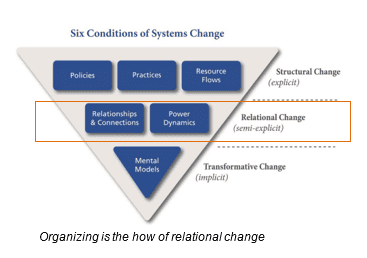
Organizing is the practice of cultivating the relationships and connections that fuel the collective power needed to address the conditions that hold a problem in place. In our work at FSG, sometimes the middle row of the Water of Systems Change framework can be mystifying to clients and partners, yet we often find that the people working closest to challenges intuitively grasp how fundamental relationships are to creating lasting change. Our goal is to dispel some of the myths surrounding organizing and to invite philanthropy to embrace organizing and community power-building as potent strategies for advancing change at scale.
Common Misconceptions about Community Organizing
There are a series of common misconceptions about community organizing that we see as barriers to more support flowing into this crucial work. Many funders see organizing as too risky, too unpredictable, and too ineffective to invest, when the opposite is true.
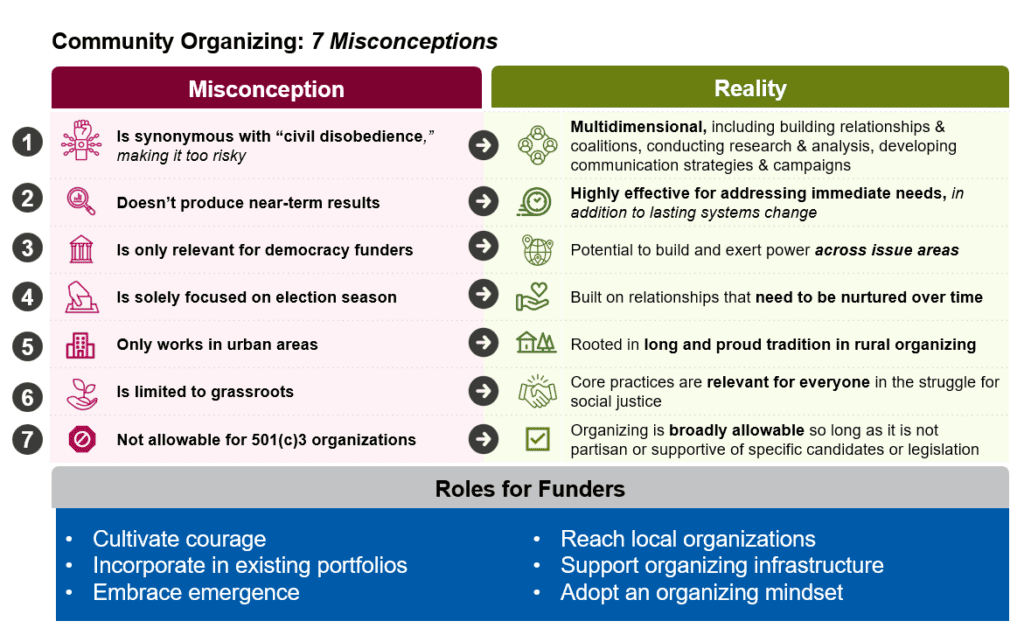
In this article, we will examine each of these misconceptions and elevate several roles for funders.
Community organizing is civil disobedience: Some of the most visible and memorable examples of direct action in both contemporary and historical movements are instances of civil disobedience, or the active, nonviolent refusal to follow laws viewed as unjust. From Rosa Parks to Standing Rock, civil disobedience has been a powerful form of protest and a valuable tool for raising awareness. However civil disobedience is just one of the many tools of community organizing, which can include other forms of public action, relationship and coalition building, power analysis, research, communications and campaigns, lobbying and legislative action, and leadership development. Much of this other important work of organizing is less visible, and so many funders who conflate organizing with civil disobedience see organizing as too risky and too provocative to support.
Community organizing doesn’t produce near-term results: Community organizing is one of the most powerful and effective approaches to achieving systems change. But because organizing is often associated with large-scale movements, many funders are hesitant to invest in what they see as ambiguous long-term work. At its best however, community organizing can be a highly effective vehicle for addressing immediate needs through mutual aid and relational networks, while also working to build and wield power at scale, an approach the Black Panthers termed “survival pending revolution.”
- For example, in 2022 when storms caused the water treatment plant in Jackson, MS to fail, it was the Mississippi Rapid Response Coalition, a group of more than 30 organizations created in 2020 with the help of People’s Advocacy Institute and the Jackson People’s Assembly, that led efforts to distribute safe water and filters to families across the city. In this way, organizing is an essential approach to building the infrastructure of community resilience; the same networks that can be activated to turn people out for a rally can be activated to meet immediate needs.
Community organizing is only relevant for democracy funders: Some funders think that if they aren’t working on civic engagement and democracy, organizing is not relevant to them. But organizing is an integral approach for building and exerting power across issue areas and does not always require the addition of new grantees. The integration of social services and base building is a key issue for organizers today, and has long historical precedent, as seen in the labor movements of the late 19th and early 20th century.
Community organizing is only important during election season: Funding for organizing often rises and falls with electoral cycles as funders rush to support voter registration, education, and get-out-the-vote activities. While these are important strategies, effective organizing is built on relationships that need to be nurtured over the long term – they can’t be turned on and off. Even for civically or politically motivated funders, the work of city, county, and state government happens year in and out, presenting numerous meaningful opportunities for greater public participation, and when needed, resistance to slow down or stop damaging policies.
Community organizing us urban: Community organizing is often thought of as an approach that is unique to urban environments. However, there is a long and proud tradition of rural organizing, from agricultural movements like the Grange to more contemporary examples like Reclaim Idaho, which organized a successful campaign for Medicaid expansion in that state, or A Better Chance a Better Community, which organizes youth and residents across multiple communities in rural North Carolina to build connections and take action on shared priorities. While the tactics and absolute numbers might look different, organizing practices are equally relevant for rural communities. Rural organizing can also have widespread benefit by bringing rural perspectives and voices into diverse coalitions around issues of regional or national importance, such as food systems, immigration, climate change, AI, and shared economic prosperity.
Community organizing is only for the grassroots: For many funders, organizing conjures images of volunteers congregating in informal spaces and canvassing neighborhoods. While organizing is one of the most important tools available for communities to build and use power, its core practices are relevant for everyone in the struggle for social justice. Building relationships, establishing a constituency or coalition, and developing a shared understanding of problems and how to address them are all essential practices for leaders regardless of their role in the social sector. Indeed, funders and others who hold traditional forms of power can be even more effective and accountable to the communities they serve when they lean into their positionality and employ organizing practices to increase their capacity for influence.
Community organizing is out of bounds: Funders are rightly careful about the legal and compliance aspects of their operations, which can lead some to avoid any activity that approaches the realm of politics, including organizing. In reality, foundations and nonprofits have significant latitude to engage in advocacy and civic engagement activities, so long as they avoid supporting specific parties, candidates, or legislative positions. Much of the long-term, relational work of organizing falls outside these restrictions. Organizations like the Council on Foundations and National Council of Nonprofits offer resources to help better understand these boundaries.
Roles for Funders
Philanthropy has a critical and urgent role to play in supporting community organizing. To lean into this role, funders can:
Cultivate courage: Community organizing often involves calling into question deeply entrenched power structures, systems, and practice. Foundations are often the product and beneficiary of systems of oppression. To ensure a sustained and authentic accompaniment of organizers, foundations can build the courage to not only acknowledge the source and legacy of their wealth but also work to repair their relationship to social change. Some foundations have already started to do this hard but important work. And organizations like Decolonizing Wealth Project and Grassroots International offer practical resources to support philanthropy in this journey of acknowledgement, repair, healing, and solidarity.
Identify space for organizing in existing portfolios: Integrating community organizing into your work does not require a new focus area or strategy. Rather, funders can work with their partners to explore ways to incorporate deeper and more sustained relationship building into their work, and to identify spaces and opportunities for shared learning and priority setting.
Embrace emergence: Community organizing is a highly impactful but often fluid strategy for driving change. Supporting organizing work requires greater tolerance for ambiguity and flexible approaches to measurement and learning, emphasizing progress as it relates to relationship building, leadership development, and capacity, in addition to targeted actions and results. Funders should also be open to and expect changes in strategies and priorities as organizers respond to unexpected crises and opportunities.
- For example, the New Jersey Organizing Project emerged after Hurricane Sandy to ensure community voice informed the recovery process, but over time expanded its focus to include mental health and overdose challenges highlighted in the aftermath of the storm. Funders can align with this reality by providing multi-year, general operating support[1] that allows organizations to have the financial stability to be adaptive and respond to shifting community needs and opportunities.
Ensure resources reach local organizations: Community organizing is often incredibly localized work and is built on trust and relationships. Thus, it is critical that dollars go into organizations with deep local roots, which are often smaller and place-based. It can be difficult to identify and vet these smaller organizations, and foundation processes are often designed for larger organizations, and so they can be hard to reach. In addition to exploring ways to shift these practices to direct more resources to more localized groups, funders can also work with intermediaries who have the structures, knowledge, and relationships in place to more effectively and quickly support smaller, local organizations. Intermediaries do a lot more than just pass through funds. They provide capacity building, technical assistance, fiscal sponsorship, and opportunities for networking and connection central to local organizing.
- For example, Houston in Action is building a regional ecosystem comprising approximately 100 organizations across the Greater Houston Region. They coordinate, train, and resource community organizers, communicators, and advocates; regrant millions of dollars annually; and lead campaigns that shape civic participation and improve quality of life across the region. In 2024, they began incubating a network of neighborhood-based organizations in El Paso that have been organizing against utility rate increases and the construction of a data center in the region.
Support organizing infrastructure: Relational work is bolstered by a supportive infrastructure. Organizations need spaces to meet, mechanisms for connecting with residents, access to equipment, leadership training, and so much more. However, these resources are often underinvested in or not designed with organizers in mind. Foundations can shift that dynamic by working with community organizers to identify their specific needs.
- The Hyams Foundation worked with local organizations on the Building Movement Infrastructure Project to identify the resources organizers in Massachusetts needed, such as capacity building for youth leaders and communications staff.
- Infrastructure also exists in the form of regional and national networks like the Alliance for Youth Organizing, which serves as a capacity builder, funding intermediary, and ecosystem leader for a network of local youth organizing groups around the country.
- As part of a multi-faceted strategy to build community power and achieve health equity and racial justice, the Praxis Project strengthens and grows a network of community power building organizations and allies through accompaniment, capacity building and technical assistance across geographies, issues, constituencies and identities. In this context of movement building, it means supporting the battles they are fighting in their communities for survival, resistance and construction of alternatives that uphold dignity and advance equity and justice.
Adopt an organizing mindset: Foundations have significant positional power and access to spaces and networks that many grassroots organizations do not. Philanthropic leaders can further support the communities and causes they serve by intentionally adopting core organizing principles within their own spheres of influence. This might include cultivating peer relationships that build toward shared action, making connections between grantees and other funders to unlock resources, amplifying other organizations to highlight their expertise and perspective, and identifying ways to use the foundation’s own voice and relationships to shift power and influence systems. A recent example of organizing among funders is the efforts in 2025 to defend the field of philanthropy and nonprofits.
At the end of the day, funders and organizers share the same goal of supporting communities as they work to thrive and achieve lasting change. We encourage funders of all types to deepen their embrace of community organizing, whether they are starting for the first time or already include it in their portfolios. And for those wondering how to start, you can take a page from the organizing playbook: it all begins with relationships.
_______
[1] In general, the principles of Trust Based Philanthropy are well suited to supporting community organizing

