Roadmap to Improve Gender Equity for Renewable Energy Companies
Industry Overview
Renewable energy (RE) spans power generation, storage, transmission and distribution (T&D), across manufacturing, construction/ installation, and operations and maintenance (O&M) functions. As of 2025, the industry employs approximately 1.28 million workers[1] in RE generation, with storage, T&D employing an additional ~1.8 million workers;[2] generation alone is expected to grow at 10% CAGR[3] to approximately 2.3 million workers by 2030. This growth is driven by rising electricity demand from economic growth and urbanisation, government targets for renewable capacity, declining costs of solar and wind technologies, and increasing investment in grid infrastructure and energy storage.
Why should renewable energy companies aim to improve gender equity in entry-level roles? [5]
Hiring more women can:
- Improve work culture (e.g., lower absenteeism amongst women)
- Improve productivity (e.g., women complete tasks in less time)
- Lower attrition (e.g., higher retention amongst women)
Why do renewable energy companies have low gender equity today? [4]
Company-level challenges
- Managers are reluctant to hire women for roles involving heavy lifting, working at height (e.g., wind turbine erector), or equipment handling
- Sites lack adequate women-friendly infrastructure (e.g., sanitation facilities, women-only rest areas, and safety provisions)
- Leadership places limited priority on gender diversity
Ecosystem-level challenges
- ITI courses relevant to technical roles have low female enrolment
- Families do not permit women to work in field/ mobile roles or in remote locations due to safety concerns
- Remote sites lack access to affordable and safe transport, particularly during late working hours
Where is the opportunity to add more women in renewable energy industry?[4]
Key entry-level roles include:
- Unskilled general construction labour (e.g., brick laying labour, solar panel installer)
- Skilled/ specialised construction labour (e.g., assistant electrician)
- Site upkeep and support (e.g., grass-cutting worker)
- Technical O&M (e.g., battery technician)
- Line and corridor operations (e.g., fitter)
- Customer-end operations (e.g., meter reader)
The renewable energy industry has a gender diversity of <10%, and can add more women in the following roles:
- Unskilled construction, upkeep roles, and customer operations offer the highest potential to hire women with minimal investments. Most of these roles require only an 8th or 10th grade qualification, making them accessible to non-graduate women
- Skilled roles offer limited potential due to higher entry barriers and lower workforce volumes
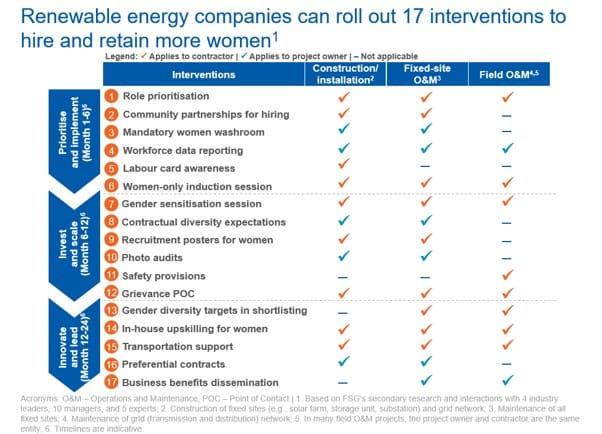
How can renewable energy companies make entry-level roles more gender-equitable?[4]
- Prioritise and implement (1-6 months): Lay the foundation by prioritising lower entry-barrier roles, building inclusive hiring practices (e.g., community partnerships), and ensuring basic facilities (e.g., washrooms)
- Invest and scale (6-12 months): Embed gender inclusion into day-to-day operations by sensitising managers on gender biases, setting diverse hiring guidelines for contractors, and investing in safety (e.g., SOS protocols) and grievance redressal systems
- Innovate and lead (12-24 months): Sustain and scale progress by upskilling women workers, providing transportation support, incentivising contractors through preferential contracts, and sharing the business case for gender diversity
How can renewable energy companies track their progress on gender equity?
The Gender Equity Readiness Scorecard (GERS) is an open-source tool which offers a quick, objective assessment of gender equity within a company. The renewable energy GERS tool evaluates progress on gender equity across four dimensions – outcome, accountability, facilities and support, and inclusive hiring and onboarding.
Renewable energy companies can use the GERS tool to get a clear, objective baseline of their performance on gender equity in entry-level roles, identify the next set of practices to implement, and track progress over time. Ecosystem players (e.g., governments, funders) can leverage the GERS to nudge companies to prioritize gender equity, benchmark companies on their performance, identify emerging trends and challenges, and prioritise specific incentives/ programs for improving gender equity in the industry.
To start your gender diversity journey, download the gender equity roadmap>
To access the GERS excel tool, click here >
If you want support implementing this roadmap, email us at GLOW@fsg.org >