Roadmap to Improve Worker Experience and Gender Equity for Construction Companies
Industry Overview
Construction includes general (e.g., masonry) and specialised construction activities (e.g., electrical work) in residential/ commercial buildings and infrastructure projects. As of 2025, the construction industry employs approximately 74 million workers.[1] Headcount in construction is expected to grow at 5% CAGR to approximately 95 million by 2030.[2] This growth is driven by rising demand for residential and commercial buildings due to population growth and urbanisation, and increasing government expenditure on infrastructure.
Why should construction companies aim to improve worker experience and gender diversity in entry-level roles?[3]
Improving worker experience and gender diversity in entry-level roles can:
- Improve retention (e.g., workers staying longer at sites providing timely wages and better facilities)
- Improve productivity (e.g., better output in terrace waterproofing by women)
- Expand talent pool (e.g., more women in skilled roles)
What challenges do construction companies face in improving worker experience and gender diversity in entry-level roles today?[3]
Company-level challenges
- Companies place limited priority on improving worker experience due to competing business priorities
- Companies place limited priority on gender diversity due to low perceived business benefits
- Companies hire entry-level workers as casual labour without defined terms/ contract (e.g., leaves, benefits)
- Women do not progress into skilled roles due to limited access to male-dominated on-the-job training
Ecosystem-level challenges
- Some construction roles are physically challenging for women (e.g., steel work involving heavy lifting)
- Many workers do not have labour cards[4] due to low awareness and lack of documents (e.g., work proof)
- Families do not allow women to migrate for construction work, especially unaccompanied by male family members
- Women do not opt for skilled roles due to internalised gender norms that deem skilled roles unsuitable for them
Where is the opportunity to add more women in construction industry?[3]
Key entry-level roles on construction sites include unskilled roles (e.g., helpers, brick layers) and semi-skilled or skilled roles (e.g., masons, crane operators, electricians). Most of these roles require minimal education and some on-the-job experience, making them accessible to non-graduate women. The construction industry has a gender diversity of ~12% and has high potential for employing more women in entry-level roles in three areas:
- Buildings construction accounts for ~78% of the on-site workforce but has low gender diversity at ~10%
- Unskilled roles account for ~60% of the on-site workforce and have lower barriers to entry for women than skilled roles, but have low gender diversity at ~15-20%
- Semi-skilled/ skilled roles account for ~40% of the on-site workforce but have very low gender diversity at <5%, with potential to add women in roles with lower entry barriers (e.g., interior painting, tiling)
How can construction companies and ecosystem stakeholders improve worker experience and gender diversity in entry-level roles?[3]
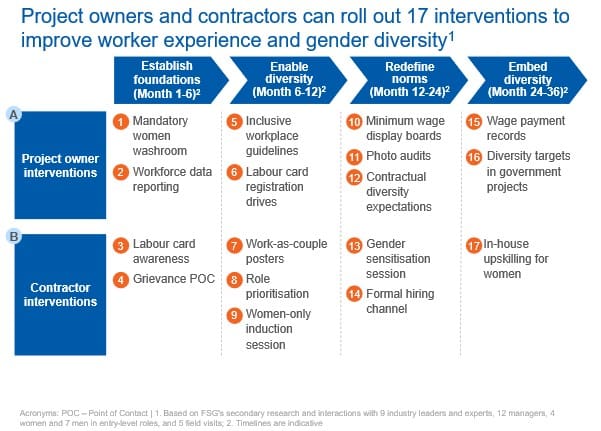
Project owners and contractors[5] can roll out interventions in phases to improve worker experience and gender diversity:
- Establish foundations (1–6 months): Initiate change by ensuring washroom access for women, capturing workforce data by gender, and briefing workers on labour card benefits
- Enable diversity (6–12 months): Support women’s entry into on-site roles by prioritising them in easy-to-fill roles, encouraging male workers to refer their spouses, and steering contractors toward inclusive workplace practices
- Redefine norms (12–24 months): Promote fair workplace practices through minimum-wage display boards, photo audits of facilities, and sensitisation sessions on unconscious gender biases
- Embed diversity (24–36 months): Sustain and scale progress through in-house upskilling pathways for women and diversity targets in government projects
Ecosystem stakeholders can focus on four areas to improve worker experience and gender diversity in construction:
- Improve skilled women-worker pipeline: Fund or facilitate women’s skilling programmes in construction trades, and run campaigns showcasing women in skilled roles
- Improve workplace conditions: Encourage greater transparency on on-site facilities and workforce gender composition through regular data disclosures
- Improve access to benefits: Support labour card[4] awareness campaigns and registration drives for workers, and simplify registration and claims processes
- Strengthen the business case: Fund or conduct pilots that build evidence on the business benefits of hiring women and formalising the workforce
How can companies track their progress on worker experience and gender equity?
The Worker Experience and Gender Equity Scorecard is an open-source tool which offers a quick, objective assessment of worker experience and gender equity on construction sites owned/ operated by a company. The tool evaluates progress across five dimensions – outcome, accountability, employment practices, inclusive hiring and onboarding, and workplace facilities and support.
Construction companies can use the tool to get a clear, objective baseline of their performance on worker experience and gender equity in entry-level on-site roles, identify the next set of practices to implement, and track progress over time. Ecosystem players (e.g., governments, funders) can leverage the tool to nudge companies to prioritise improving worker experience and gender equity, benchmark companies on their performance, identify emerging trends and challenges, and prioritise specific incentives or programmes for improving worker experience and gender equity in the industry.
To start your gender diversity journey, download the gender equity roadmap >
To access the excel version of the scorecard, click here >
If you want support implementing this roadmap, email us at GLOW@fsg.org