


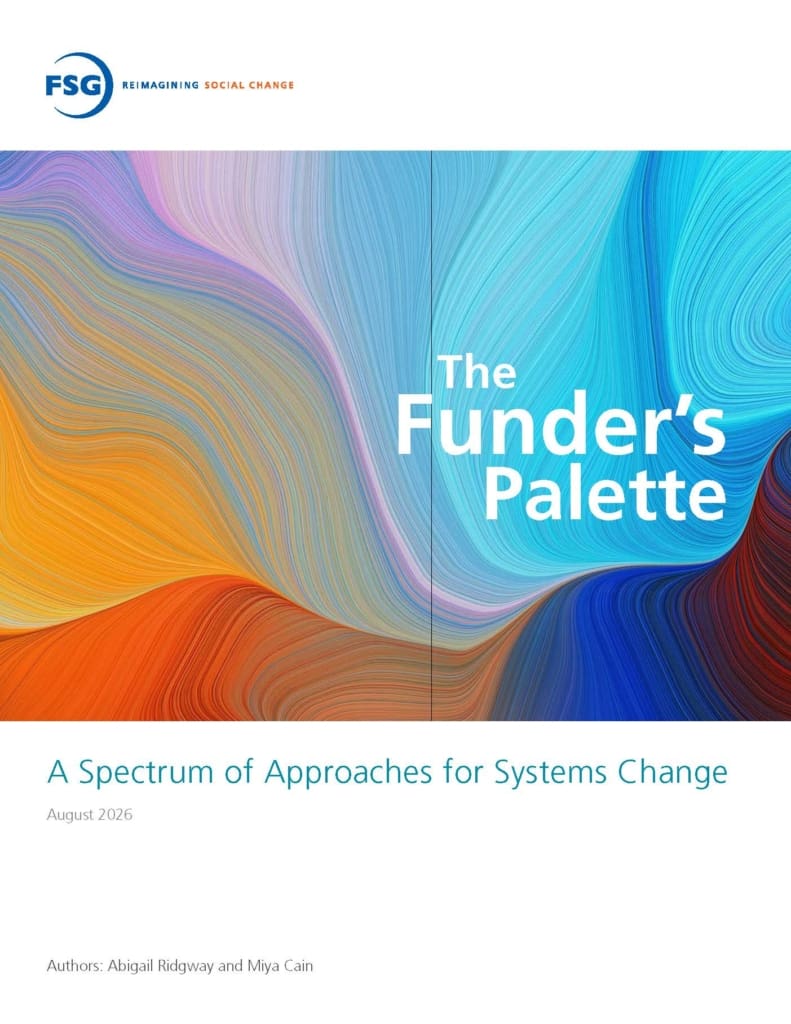
Over the last several years, foundations have entered a new era defined by experimentation, adaptation, and a broader vision of what it means to create change. Philanthropy is evolving, and with it, the role foundations play. Increasingly, foundations are stepping beyond the work of funding nonprofit programs to explore how else they can influence the systems that shape communities. This is a moment full of possibility, and it calls for new thinking, new tools, and new ways of working together.
This effort was born from a simple question: How can foundations best contribute to equitable systems change? To answer that question, we examined some of the most compelling examples of systems change we know and looked for the common approaches, tools, and mindsets that enabled those successes.
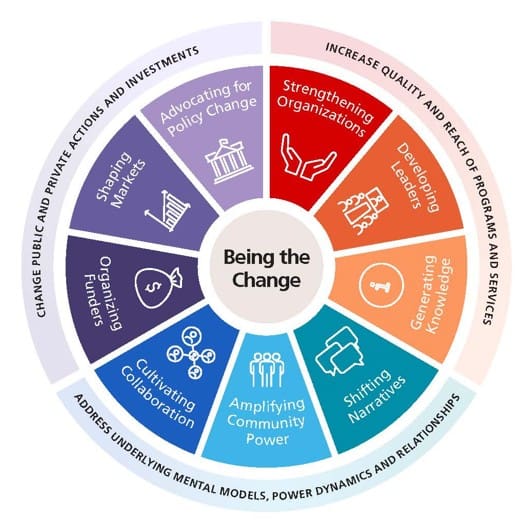
This report is intended to help people working in philanthropy —staff, leadership, boards— better understand the full range of tools available to them. The research provides insights from on-the-ground practitioners who are changing systems, at-scale, in their communities. They include reflections from those who have increased graduation rates for foster youth, developed youth-led mental health programs, reduced toxic chemicals in cosmetics, transformed child welfare, embedded brain development concepts into a regional early learning curriculum, defended local journalism, reduced maternal mortality, preserved Medicaid expansion in their state, halted evictions during COVID, and increased youth peer support. Through these stories, we see examples of how the following approaches have contributed to systems change.
For each of these approaches, here’s what you’ll find in the pages that follow:
Foundations are being asked to show up differently, and many already are. They’re deepening their impact by strengthening leaders, reshaping systems, shifting markets, and rebalancing power. This paper is an invitation to keep evolving, keep learning, and keep pushing the boundaries of what’s possible.
This paper was informed by FSG’s 25 years of work in the philanthropic field and over 125 practitioner interviews on this topic. In writing this report, we asked our colleagues and partners about the most inspiring recent examples of advancing systems change, and what most enabled those changes. We would like to thank our colleagues and the many field leaders who graciously contributed expertise, examples, and insight to help shape this report.
Remaining Focused and Purpose-Led During Uncertainty introduces a framework of four strategic response domains for funders to consider
A Four-Domain Spectrum for Funder Engagement in AI: From Institution to Ecosystem

You will also receive email updates on new ideas and resources from FSG.
"*" indicates required fields
You will also receive email updates on new ideas and resources from FSG.
"*" indicates required fields
Get updates on new ideas and resources from FSG.
"*" indicates required fields
| Cookie | Duration | Description |
|---|---|---|
| cookielawinfo-checkbox-analytics | 11 months | This cookie is set by GDPR Cookie Consent plugin. The cookie is used to store the user consent for the cookies in the category "Analytics". |
| cookielawinfo-checkbox-functional | 11 months | The cookie is set by GDPR cookie consent to record the user consent for the cookies in the category "Functional". |
| cookielawinfo-checkbox-necessary | 11 months | This cookie is set by GDPR Cookie Consent plugin. The cookies is used to store the user consent for the cookies in the category "Necessary". |
| cookielawinfo-checkbox-others | 11 months | This cookie is set by GDPR Cookie Consent plugin. The cookie is used to store the user consent for the cookies in the category "Other. |
| cookielawinfo-checkbox-performance | 11 months | This cookie is set by GDPR Cookie Consent plugin. The cookie is used to store the user consent for the cookies in the category "Performance". |
| viewed_cookie_policy | 11 months | The cookie is set by the GDPR Cookie Consent plugin and is used to store whether or not user has consented to the use of cookies. It does not store any personal data. |
