


A bold target of 70% women’s workforce participation by 2047 has been set for a Viksit Bharat or developed India. Change is underway and women’s participation has risen from 33.9% in 2022 to 40% in 2025. However, the gains have been largely limited to rural India. Urban women’s participation has improved only marginally — from 24.7% to 27.7% — over the same period. Further, the share of urban working women in regular wage/ salaried jobs, which offer higher wages and greater job security compared to self-employment or casual work, has stagnated at ~50-51%.
The reality is that women want to work. What stands in their way is a set of mutually reinforcing barriers within companies and across the ecosystem. Overcoming them requires coordinated action across multiple stakeholders. Drawing on FSG’s primary research with 6,600+ women, our experience supporting 20+ companies on their gender diversity journeys, and the industry and ecosystem expertise of our co-authors, this report names the key barriers and lays out 15 insights to overcome them. The focus throughout is on formal, entry-level jobs in large, high-growth industries such as manufacturing, retail, and hospitality. These jobs align with women’s needs and have the volume to absorb women at scale.
Insights to boost women’s participation in entry-level roles
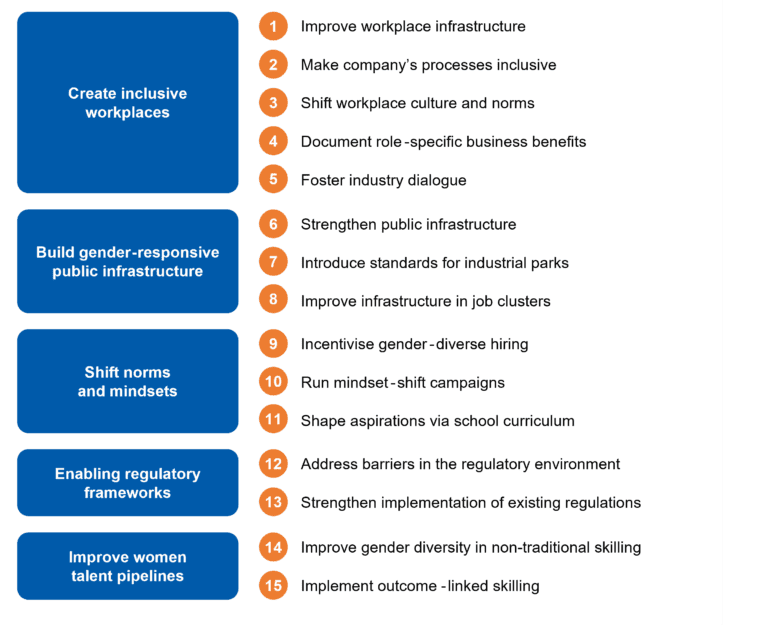
Companies need to rewire their workplaces through a gender lens so that women can access jobs, feel safe and supported, and succeed in them. This involves investing in women-friendly infrastructure, redesigning hiring and people processes, and fostering a respectful, equitable and supportive work environment. At the same time, change needs to happen across the broader ecosystem too. Governments, funders, and civil society organisations need to work together to strengthen gender-responsive public infrastructure, expand women’s access to non-traditional skilling, reform and operationalise conducive regulations, generate evidence on the business benefits of employing women, and shift social norms around women’s work. Together, these complementary actions can create an enabling environment that allows millions more women to enter, remain, and progress in the workforce.
Change at scale will take time, but individual action need not wait.
“Start where you are. Use what you have. Do what you can.” – Arthur Ashe