Roadmap to Improve Gender Equity for Process-based Manufacturing Companies
Industry Overview
Process-based manufacturing industry includes the manufacturing of food and beverages, metals, non-metallic mineral products, chemicals, and other manufactured goods (e.g., leather, plastics, toys). As of 2025, the industry employs approximately 38.2 million workers,[1] and headcount is expected to grow at 8.4% CAGR to approximately 57 million by 2030.[2] This growth is driven by the government’s push via production-linked incentives, import substitution, rising domestic consumption, and a sustained public and private investment in infrastructure.
Why should process-based manufacturing companies aim to improve gender equity?[3]
Hiring more women can:
- Improve work quality (e.g., fewer errors in products assembled by women, lower rejection rate of products inspected by women)
- Improve productivity (e.g., more products packed per hour by women)
- Improve work culture (e.g., lower attrition amongst women)
Why do process-based manufacturing companies have low gender equity today? [4]
Company-level challenges
- Mangers perceive it as inappropriate for women to work in male-dominated plants
- Managers are reluctant to hire women for roles involving heavy lifting/ working at height (e.g., machine operators)
- Managers do not hire women in night shifts because of safety concerns
- Leadership places limited priority on gender diversity
Ecosystem-level challenges
- Plants, in remote areas or during late hours, lack affordable and safe transport facilities
- Some laws make women uncompetitive in labour market (e.g., mandatory pick-up and drop for night shifts, maternity benefits act)
- Some state laws restrict women’s participation in hazardous processes such as chemicals and metals
- Societal expectations limit women’s enrolment in non- traditional ITI courses required for certain roles (e.g., machine operator, welder)
Where is the opportunity to add more women in process-based manufacturing industry? [4]
Entry-level roles in process-based manufacturing industry include production roles such as production/ assembly line worker, machine operator, quality inspector, stitching roles, and support roles such as packer, store assistant, and security. Most of these roles require only a 10th or 12th grade qualification, making them accessible to non-graduate women. The process-based manufacturing industry has a gender diversity of ~18%,[1] and can prioritise employing more women in entry-level roles in these areas:
In sectors with >10% gender diversity (e.g., food and beverage, non-metallic minerals):
- Perceived easy roles (e.g., packaging, quality) in general shift in North India
- Perceived difficult roles (e.g., machine operator) in general shift across locations
- All roles in night shift in South and West India
In sectors with <10% gender diversity (e.g., metals, furniture):
- Perceived easy roles (e.g., packing, quality) in general shift across locations
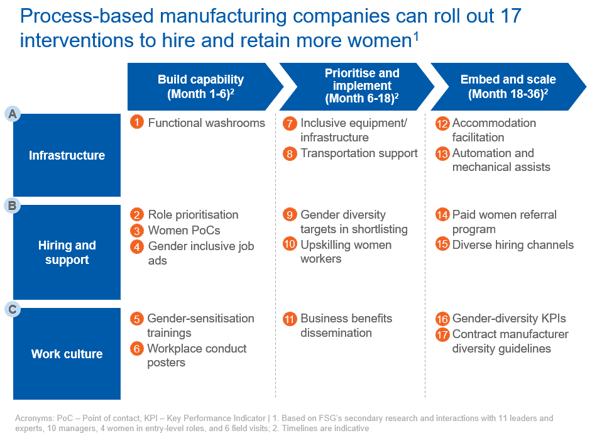
How can process-based manufacturing companies make the roles more gender-equitable? [4]
- Build the organisation’s capability (1-6 months): Lay the foundation by building basic infrastructure (e.g., washrooms), implementing inclusive hiring practices, establishing dedicated support for women (e.g., woman POC), and sensitising managers on gender biases
- Prioritise and implement (6-18 months): Ensure sustained focus by investing in transport support, strengthening hiring, training (e.g., upskilling women workers) and retention practices, and building buy-in via business benefits dissemination
- Embed and scale (18-36 months): Institutionalise gender diversity by investing in accommodation and automation, diversifying hiring channels, and embedding accountability via internal diversity KPIs and guidelines for contract manufacturers
How can process-based manufacturing companies track their progress on gender equity?
The Gender Equity Readiness Scorecard (GERS) is an open-source tool which offers a quick, objective assessment of gender equity within a company. The process-based manufacturing GERS tool evaluates progress on gender equity across four dimensions – outcome, infrastructure, workplace practices, and accountability.
Process-based manufacturing companies can use the GERS tool to get a clear, objective baseline of their performance on gender equity in entry-level roles, identify the next set of practices to implement, and track progress over time. Ecosystem players (e.g., governments, funders) can leverage the GERS to nudge companies to prioritise gender equity, benchmark companies on their performance, identify emerging trends and challenges, and prioritise specific incentives/ programs for improving gender equity in the industry.
To start your gender diversity journey, download the gender equity roadmap>
To access the GERS excel tool, click here >
If you want support implementing this roadmap, email us at GLOW@fsg.org.